By BEN CAMERON
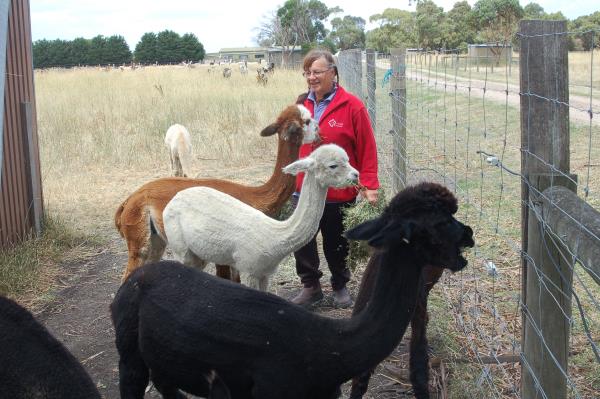
THEY might be the Cardinia Shire’s newest television stars, but alpacas Dawson and Geraldine are still pretty camera shy.
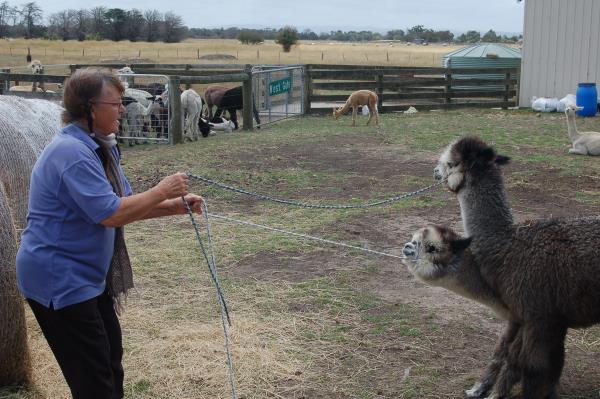
Without hay, it’s proving pretty difficult to get them together for a quick photo shoot on Joy Skinner’s 20-acre Cardinia property.
Despite having to chase the elusive pair around the paddock with a piece of rope for 10 minutes, Joy can’t contain the high she’s riding right now.
A few months ago she was recommended to a television station to provide alpacas for a new comedy show to be released later this year.
She’s tight-lipped on the details, but can’t wait to let the cat fully out of the bag after two days filming late last year.
“I can’t say much, but I had to take four down to the movie studios in Docklands,” she says.
“I’m stoked, I’ve never done anything like that before.”
After the Gazette’s reporter scales a fence to grab some hay from the back of Joy’s 4WD, Dawson and Geraldine, and about 15 other alpacas, are no longer shy and are suddenly swarming us.
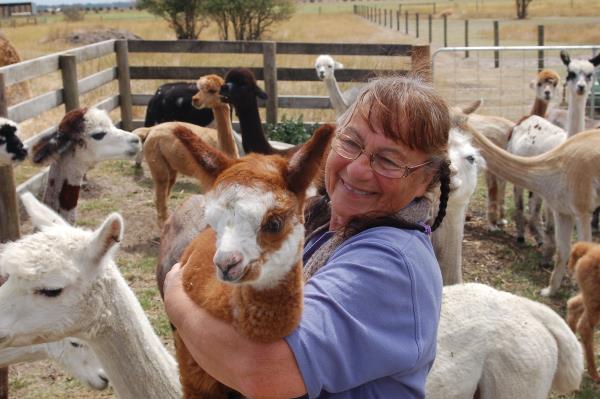
“These are my little movie stars,” Joy says lovingly, as Dawson nibbles the hay from her hand.
“Although they badly need a haircut.”
The “fluffy” Dawson and Geraldine are two of the nearly 170 alpacas which roam Joy’s property at Almora Alpacas, which she’s called home since 1981.
She remembers all of their names, although it can be difficult after they’ve had their annual haircut.
“All the black ones look the same after they’re shorn,” she laughs.
This place is a world away from Joy’s childhood.
Although “city born and bred” in the eastern suburb of Carnegie, Joy was destined for a life on the land.
“I always had country in my heart, always,” she says.
“I had animals in my heart – it didn’t come from my mum or my dad, it came out of nowhere really.”
The former city chick is now somewhat of an amateur vet these days when it comes to this unique animal.
“I’m not a vet by any means, but I’ve learnt a lot,” she says. “I’m learning new stuff all the time.”
And with her two grown-up children having left years ago, she has a new brood to care for.
“I’m totally addicted,” she laughs.
“They’re my whole life; my kids reckon I love the alpacas more than I love them. Which is not strictly true.
“All the other grazing animals I had gradually died out.
“I’ve tried most things, but alpacas won in the end (laughs).
“It’s just me and them now.”
For Joy, it was love at first stroke, after she first locked eyes on one at an open farm day near Hastings.
“I touched one in 1992, and I fell in love with them instantly,” she says.
“It was the first time I’d ever set eyes on one; they first came out here (to Australia) in ‘88.
“I had an instant rapport with them, it was mainly the feel of the fleece to start with.”
She didn’t muck around, and the exorbitant price didn’t put her off buying her first three in 1994.
“The first ones cost me an absolute arm and a leg, but I had to have ’em,” she laughs.
How much?
“$36,000 for my first three,” she says.
“There were no animals to chose from back then, you had to take what you can get.”
Since 1994 she’s seen around 360 alpacas come and go on the farm.
And when she’s not working in the deli at Woolworths in Berwick, she’s “selling a few, and breeding a lot”.
Prices start from $350 and Joy has no shortage of buyers.
Her alpacas don’t just provide an income, but also a sense of pride.
As she pours the coffees in the kitchen, you notice the many ribbons lining the bottom of the bench; about seven shows’ worth, to be exact.
“I’ve got two more shows (in Berwick and Red Hill) to go so hopefully I’ll fill it,” she laughs.
“I do fairly well, I’m probably middle of the range.
“I was at the top when I had one called Nomad who was a grey, but I lost him a couple of years ago.
“(His cause of death was) unknown really – don’t really know, he just died at age seven, which was a bit of a shock.”
When alpacas are your number one passion in life, is it difficult to watch them pass away?
Most live to between 17 and 22 years of age, although Joy once had one that lived to 24.
“It’s life,” she says, bluntly.
“I do get attached, but you’ve got to be realistic. I believe once something’s dead, it’s dead.
“You move on. You can’t do anything about it once it’s happened. It’s farming, you’ve gotta roll with the punches, really.”
While Joy has come to learn a lot about alpacas, much of it, like breeding, is based simply on gut feeling.
She breeds about 50 each year.
“It’s what I call sorting,” she says.
“Working out who’s pregnant and who’s not. People ask how I work out who mates with who.
“I go with gut feeling nore than anything, some people are more scientific.
“But people say it’s working, so keep doing it,” she laughed.
Joy says alpacas are spiritual animals.
“They hum a lot,” she says.
“They agree with everything you say.
“You can be out in the paddock whinging about your partner and they’ll just say “hummmmm”.
“In a way they’re spiritual, to a lot of people. They’re just nice to be around, I reckon.”
They’re also fiercely protective.
“Alpacas guard sheep when they’re lambing, I rent them out to farmers,” she says.
“Farmers swear by them. They’re pretty good.”
With foxes roaming nearby, Joy has a special paddock reserved for babies, which is in sight from the kitchen: “All my babies are born in that paddock so I can watch them.”
Joy hints that she might one day leave the property, to be closer to her daughter in Hervey Bay.
“That’s if I ever get alpacas out of my system,” she says.
You wonder if that day will ever come.