By ALISTAIR KENNEDY
CITROEN is a carmaker that has traditionally stretched the envelope in terms of both design and technology.
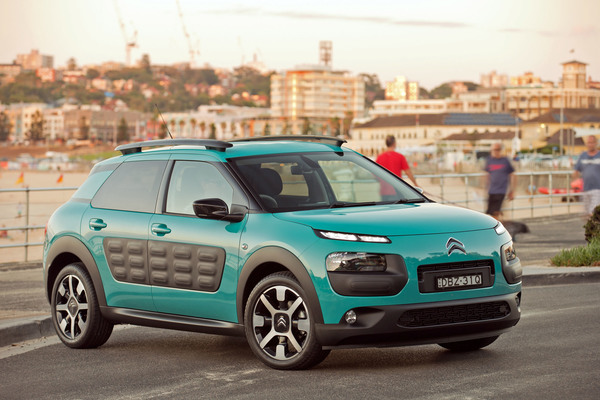
Sadly, in recent decades it’s taken a more mainstream approach so it’s great to be able to announce the arrival of the delightfully-different C4 Cactus SUV / hatchback crossover.
Cactus has been on sale in Europe for nearly two years and with the compact SUV segment booming, Citroen Australia would have loved to have had it here earlier.
Unfortunately delays in right-hand drive production and the lack of a top tether and child restraint points for the centre rear seat led to the long delay.
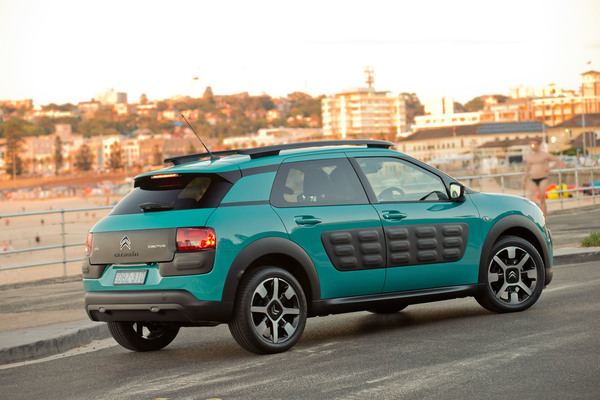
The standout feature, certainly the biggest talking point, in the Cactus will undoubtedly be its AirBump panels.
Partly cosmetic, partly functional these are hard plastic inserts that are embedded into the car’s doors.
Together with a series of protruding soft air-filled pockets they act as shock absorbers to protect the sides of the car from day-to-day bumps and scrapes.
There are also smaller Airbumps to protect the headlights although the bumper bars themselves remain hard plastic.
As part of the launch program for the Cactus we were able to put Cactus to a supermarket trolley torture test and despite a series of solid impacts – more thumps than bumps – the AirBumps emerged unscathed.
C4 Cactus comes with the choice of two engines, 1.2-litre three-cylinder turbo petrol and 1.6-litre four-cylinder turbo-diesel. The petrol is a 81 kW / 205 Nm (from 1500 rpm) PureTech unit and will come with a five-speed manual gearbox; the diesel 68 kW / 230 Nm (from 1750 rpm) and six-speed semi-automatic transmission.
Standard on both variants are roof rails; LED daytime running lights; front foglights with a cornering function; reversing camera; rear parking sensors; satellite navigation; DAB+ digital radio; Bluetooth phone and audio streaming; and a USB socket.
Safety features include six airbags; ABS brakes with emergency brake assist and electronic brakeforce distribution; electronic stability and traction control; two rear Isofix child seat mounting points; tyre pressure monitoring; reversing camera; rear parking sensors; and hill start assist
There’s good interior space with plenty of headroom throughout and acceptable legroom in the rear. It’s bright and airy, especially with the optional panoramic sunroof which according to Citroen blocks out 99.9 per cent of UV rays.
The rear windows are of the hinge-out variety which may not appeal to everyone although the lack of the usual wind-up mechanism allows for larger door storage pockets as well as cutting 11 kg from the car’s weight.
There’s also extra front storage space courtesy of an 8.5-litre top-opening glove compartment which can operate in that way because the front passenger’s airbag is fitted within the roof rather than inside the dashboard.
Even with a 15-inch steel spare wheel (fitted wheels are 17-inch alloys) below its floor the boot is rather low. It has a reasonable capacity of 358 litres, 1170 litres with the rear seatbacks folded.
Prices for the C4 Cactus are $26,990 for the petrol/manual model and $29,990 for the diesel/automatic.
One of the car’s biggest attractions will be its vast array of personalisation options with a choice of ten body colours, nine of which are classed premium colours with a surcharge of either $800 or $1000).
There are also different, generally contrasting, colours for the AirBumps, door mirrors, wheels, roof bar and even the Cactus lettering on the rear side panel. Only the black AirBumps, door mirrors and roof bars are standard, other colours are extra cost options.
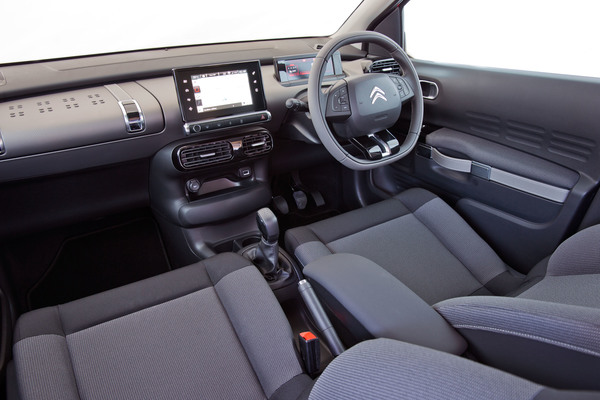
There are also six different interior trim options for the seat trim and dashboard. Once again only one is standard, the other five will cost either $800 or $1600.
With 60 per cent of pre-orders including some level of personalisation and an expectation that this will continue prices are likely to rise, often significantly, over the base rrps.
Indeed Citroen Australia tells us that one fully-personalised diesel Cactus has been ordered with a price of $42,000, albeit including on-road costs.
Buyers who get in early enough will be able to select from 23,000-plus possible combinations although eventually the bean counters will put their foot down and the options will be pruned back to a more manageable level.
So if you’re looking for some outrageous colour combinations then it would be best to get in quickly.
The launch drive program took up from Newcastle to the Hunter Valley then down the Putty Road to Sydney.
We were able to have extended drives in both Cactus variants and rarely have we come away with such divergent views about two transmissions.
We struggled with the automated manual in the diesel car but loved the manual with the turbo-petrol. The single-clutch robotised auto is jumpy and surges around in an unpredictable manner.
The delay from first to second gear is the most noticeable and the most worrying.
The Cactus diesel/auto uses what Citroen calls an “Easy Push” gear selector which comprises three large buttons (Drive, Reverse and Neutral – there is nor Park option) mounted on the dashboard.
The parking brake is a bulky aircraft-style push up/down unit.
Recognising this problem we understand that Citroen dealers are being trained to teach potential buyers how to adapt their driving techniques to a type of gearbox that they haven’t experienced before.
Such is the contrast between the two transmissions that we wouldn’t be all surprised to see Citroen’s predication of an 85 per cent take-up of automatics falling short for anyone who does a comparison test drive.
By contrast the five-speed manual in the 1.2-litre turbo-petrol is a little gem and a clear choice for those who like to do their own gear changes.
It’s not hard to understand why the little Puretech engine took out the 2015 International Engine of the Year award. It’s sharp off the mark and gets to 100 km/h in 9.3 seconds, two seconds quicker than the diesel.
The engine has its own distinctive sound which we enjoyed although it’s also surprisingly quiet.
The manual transmission is so pliable that, during one segment of the drive over some undulating terrain we travelled around 25 kilometres without needing to change out of fifth gear.
Listed fuel consumption is impressively low at 3.6 litres per 100 kilometres for the diesel on the combined city/highway cycle and 4.7 L/100km for the petrol.
As is invariably the case our tests were well above these numbers at 5.5 and 6.1 L/100 km respectively. We’ll get a second opinion when we take Cactus out for our extended test.
On the road Cactus is capable without any real sporty pretensions, but that’s the norm in this class.
Suspension is on the soft side, steering is light with a little more bodyroll than we’d like. Most of our 400 km behind the wheel was spent on rural roads and motorways rather than what’s likely to be its suburban natural habitat.
Again our longer test will tell us more but we’d expected it to be well-suited to that environment.
It’s always exciting to see new automotive innovations and Citroen has traditionally been a forward thinker in this regard.
To choose a name that in Australian slang means – to put it as politely as possible – something that is broken beyond repair would seem to be inviting trouble.
Having experienced this particular Cactus first-hand we’d be surprised if it ever becomes ‘cactus’ downunder.
For those looking for something that’s capable, affordable and delightfully different we’d suggest paying a visit to your local Citroen dealer for a test drive.
Like all Citroen cars the C4 Cactus will come with an impressive six-year, unlimited kilometre standard warranty.