
Armyworm infestations are devastating late spring pasture across large parts of Gippsland.
Murray Goulburn agronomist Scott Travers said the area from Woodside to Buffalo was under heavy attack from the caterpillars. There have also been reports of infestations in West Gippsland.
“They are as bad as I’ve seen them. There are lines of them squashed along the South Gippsland Highway,” he said.
“People who were getting around on 25 day rotations all of sudden have nothing in front of them.”
Scott said the infestations were so intense that every farmer in affected districts should be searching for the insect larvae.
“If you think you haven’t got them, then you aren’t looking hard enough.”
AgVic pasture and conversation specialist Frank Mickan advises farmers to check longer pasture first, where younger caterpillars chew the leaves and may leave scalloped edges.
“In some cases when the food supply (pastures/cereals) becomes severely depleted, the caterpillars start to gather together and they will ’march’ out of crops and pastures in search of food – hence the name armyworm,” Frank said.
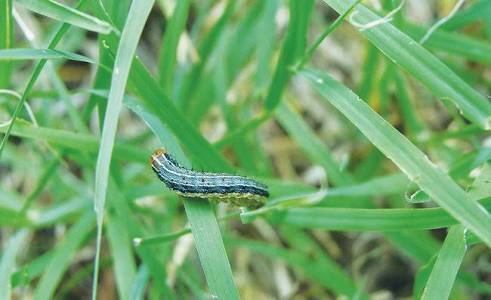
Armyworm caterpillars are smooth-bodied and have three white or creamy-coloured stripes running down their back and sides. Caterpillars can grow to about 30-40mm in length.
During the day, look under dead leaf litter at the base of the crop or pasture sward. At dusk or night, a torch should show them up on the leaves.
Early detection is essential, particularly when pasture seed or hay crops are at the late ripening stage.
Chemical treatments are available, so speak to your agronomist or advisor on how best to tackle the problem.
Early detection is essential, particularly when cereals and pasture seed or hay crops are at the late ripening stage.
To get an accurate estimates of caterpillar numbers considerable effort is required but the potential cost saving is worthwhile.
Sample by using a sweep-net or a bucket, or visually ground or crop searching for caterpillars.
The sweep-net/bucket method gives a quick and approximate estimate of problem size.
Sweep several times across the crop in 180 degree arcs, preferably about 100 times, at different sites within the crop to give an indication of density and spread.
Armyworms are most active at night so sweeping at dusk will be the most effective time.
If average catch is more than 5-10 per 100 sweeps then hop onto your knees to do some ground counts to determine approximate densities.
For ground sampling, do at least ten “spot checks“ in the crop and count the number of caterpillars within one square metre.
Young caterpillars (up to 8 mm) cause very little damage and are hard to find.
This why many dairy and cropping farmers fail to detect armyworms activity until they are nearly fully grown and damage may be as high as 10-20 per cent by then they are on the march, so the earlier you can detect them, the less the damage.
There are a number of chemicals registered for control of armyworms.
For spring outbreaks (during crop ripening) spraying is recommended when the density of larvae exceeds one to three larvae per square metre and for dairy pastures/standing hay crops, if damage is obvious, then consider hitting them.
However, also consider the following points:
– timing of harvest,
– green matter available in the crop,
– expected return on the crop, and
– caterpillar development stage (if most are greater than 35-40 mm or pupating, it may not be worth spraying).
If spraying is necessary, it is recommended that this be carried out in late afternoon or early evening for maximum effect, as armyworms are nocturnal feeders.
Be aware of the chemical being used as some are quite potent and stick to the recommended with-holding periods.
Diamondback moths, Lucerne flea and earth-mites have also been reported as damaging pastures.
Dairy Australia is currently supporting research to pinpoint the insects damaging dairy pastures across all of Victoria, southern NSW, South Australia and Tasmania, which will lead to more accurate methods to combat the pests.
For more information go to www.dairyaustralia.com.au and search pests.
Armyworms are on the march
Digital Edition

Subscribe
Get an all ACCESS PASS to the News and your Digital Edition with an online subscription

Proud Pumas create history
PAKENHAM PUMAS
History was made on Saturday as Pakenham Pumas Women’s Black etched its name into the club record books, claiming the first ever women’s...