By Frank Mickan
With recent rainfall, some potentially high quality hay, which was on the ground, may now be rain affected, reducing dry matter yields and nutritive value while increasing the difficulty of getting the hay to the desired dry matter percentage.
Hay is often baled slightly too wet due to any number of reasons including, rain, moist ground under the windrow, possibly too much dew on forage at baling, poor curing weather, nodes and seed heads still wrapped in the flag leaf sheath not being cured enough, and incorrectly calibrated or improperly used moisture meters, etc.
With the recent rain, there is potential for baling material that is possibly 2 to 5 per cent higher moisture than it should be for the particular bale form.
Large rectangular bales need to be about two per cent drier (12 – 14 per cent moisture) than large rounds (14 – 16 per cent) which themselves need to be about 2 per cent drier than the small squares (16 – 18 per cent).
This is due to the high density or large volume to surface area for the large rectangular and round bales, respectively.
Leaving wide windrows behind a mower-conditioner, tedding immediately after mowing (tedders will substantially speed up curing), and using a form of hay preservative, are all essential tools to increase the curing rate of hay.
While these practices may add cost they will likely be worthwhile, especially if the material is reasonable to high quality.
Some hay may end up in the stack that has not been cured sufficiently.
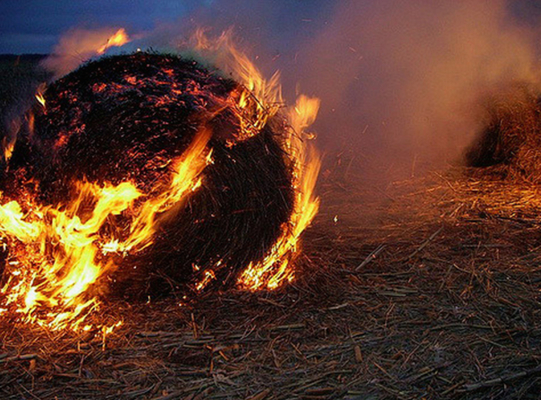
Unfortunately, this presents the possibility of mouldy hay which can increase the risk of spontaneous combustion i.e. self-ignition of hay stacks.
Regularly monitoring the stack from week one after baling for signs of heating is important.
Some of the signs to look for include:
• Heating of bales;
• Dampness on the tops of bales;
• Steam rising from the stack;
• Unusual odours (e.g. pipe tobacco, caramel, burning, musty smells);
• Moisture build-up on roofing iron or under a tarped outside stack;
• Corrosion on underside of tin roof; and
• Sometimes the stack may slump in places.
Unfortunately, much of the heating will occur in the stack centre which is difficult to pick up. To make matters worse, spontaneous combustion can be caused by only one wet bale in the stack.
To try to get a handle on how hot the stack has become, try pushing a crowbar into the stack as far as possible. After a couple of hours it can be removed and felt for how hot it is. A rough guideline to the bar’s indication of stack temperature (degrees centigrade) is:
• Under 50: can handle bar without discomfort. Check temperature daily;
• 50-60: can handle bar for short time. Check temperature twice daily. Remove equipment from shed;
• 60-70: can touch bar only briefly. Check temperature every two hours. Move hay from top layers to improve air flow;
• Over 70: bar too hot to hold. Significant potential for fire. Avoid walking on top of stack. Call the Country Fire Authority.
To measure temperatures further into the stack centre, use a steel pipe (three metres long) of approximately 20mm diameter.
Drill eight to 10 holes (4-5mm diameter) about 75mm from the end, which has been flattened to allow the pipe to be pushed into the stack.
A thermometer on string can then be lowered down and read regularly. Lay a plank or ladder across the top of the stack to walk on because there may be burnt out cavities in extremely hot stacks.
An alternative for more accurate, safer and easier monitoring, although more costly, can be achieved by thermal couplings which can be placed into various areas of the stack at stacking and monitored regularly.
For more information on farm recovery after rain and storm events, please go to the Agriculture Victoria or Dairy Australia website.
– Frank Mickan is Senior Dairy Extension Officer at Agriculture Victoria.